
- English
- Español
- Português
- русский
- Français
- 日本語
- Deutsch
- tiếng Việt
- Italiano
- Nederlands
- ภาษาไทย
- Polski
- 한국어
- Svenska
- magyar
- Malay
- বাংলা ভাষার
- Dansk
- Suomi
- हिन्दी
- Pilipino
- Türkçe
- Gaeilge
- العربية
- Indonesia
- Norsk
- تمل
- český
- ελληνικά
- український
- Javanese
- فارسی
- தமிழ்
- తెలుగు
- नेपाली
- Burmese
- български
- ລາວ
- Latine
- Қазақша
- Euskal
- Azərbaycan
- Slovenský jazyk
- Македонски
- Lietuvos
- Eesti Keel
- Română
- Slovenski
- मराठी
- Srpski језик
Are You Assuming One AC Surge Protective Device Covers Your Entire Building?
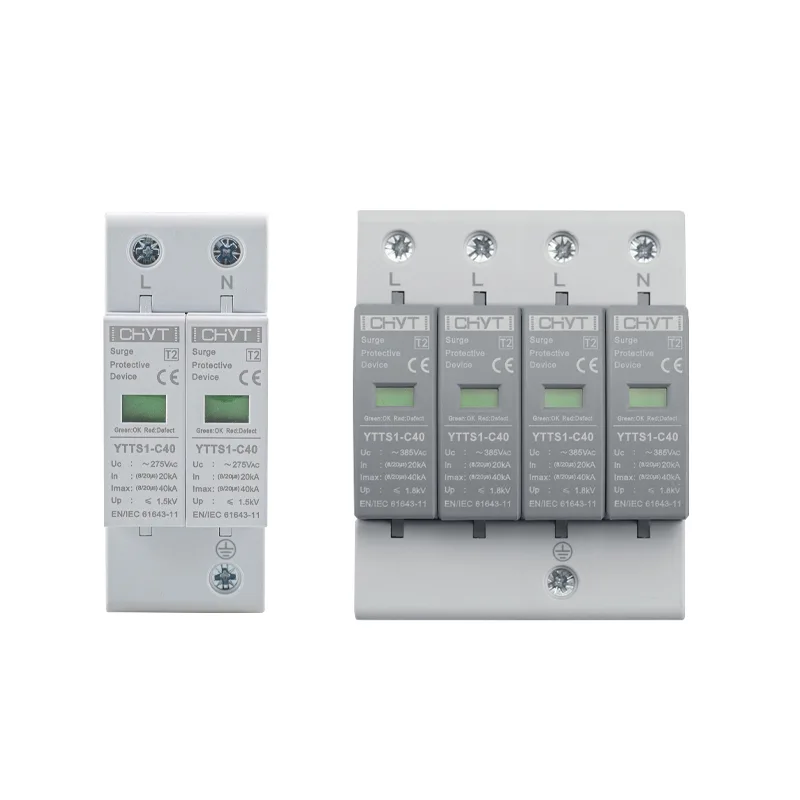
CHYT AC surge protective device applications show why one protection point may not be enough for a multi-level building.
A surge does not politely enter a building through one predetermined door. Lightning, utility switching, motor starts and stops, or faults on the local power network can introduce transient overvoltage at different points in an electrical installation. Once a surge enters a building, the wiring itself can become part of the problem, carrying the transient toward sensitive equipment.
That raises a practical question for electrical system planning: Can one AC surge protective device really protect an entire building?
In a small installation with short cable runs and limited equipment, one strategically positioned device may provide useful protection. In a larger building, however, relying on a single protection point can leave downstream circuits exposed.
Why One Protection Point May Not Be Enough
Surge protection works by diverting excessive transient voltage away from equipment and toward the grounding system. The closer the protection device is to the equipment being protected, the easier it is to control the voltage that reaches that equipment.
This becomes more complicated as a building gets larger.
Consider a three-story commercial building. The main distribution board may be located on the ground floor, while computers, HVAC controllers, lighting systems, communication equipment and other electronic loads are distributed across several floors. A surge protective device installed only at the main incoming panel cannot automatically eliminate every transient throughout the entire electrical network.
Cable length matters because voltage can still develop along conductors during a fast transient. A device that performs well at the service entrance may therefore need support from additional protection points farther downstream.
This is one reason surge protection is better understood as a system rather than a single component.
Where Transient Overvoltage Can Travel
Not every surge has the same origin or path. A direct lightning event is only one possibility. Everyday electrical switching can also create transient conditions.
Common sources include:
A transient can move from the main distribution system into branch circuits. If sensitive equipment is located some distance from the primary protection point, additional protection may be appropriate.
The following simplified view helps explain the difference:
| Building Area | Typical Electrical Role | Possible Protection Approach |
|---|---|---|
| Service entrance | Receives incoming power | Primary surge protection |
| Main distribution panel | Feeds major circuits | Coordinated protection |
| Sub-distribution panel | Supplies individual floors or areas | Additional protection where required |
| Sensitive equipment circuit | Powers electronics or control systems | Local protection when appropriate |
| Outdoor-connected circuits | Links equipment beyond the building | Protection based on circuit exposure |
The exact arrangement depends on the electrical design, grounding system, equipment sensitivity and applicable installation requirements.
The Distance Between Panels Matters
One of the easiest details to overlook is the physical distance between protection devices and loads.
Imagine a large building with the main electrical panel in one section and an automation control cabinet in another. Even if both are connected to the same electrical system, they are not electrically identical during a very fast transient.
Longer conductors introduce impedance. During a surge event, this can contribute to a voltage difference between the point where protection is installed and the point where equipment is connected.
This does not mean every outlet requires its own protection device. Instead, the protection strategy should follow the structure of the electrical distribution system.
For procurement and engineering teams, this is an important distinction. The question should not simply be, “How many surge protective devices are required?” A better question is, “Where are the points at which transient energy can enter, travel and reach sensitive loads?”
Coordination Is More Important Than Simply Adding Devices
Installing multiple surge protection devices does not automatically create a better system.
Devices installed at different distribution levels need to work together. Their characteristics, discharge capability, voltage protection level and installation arrangement should be considered as part of the complete electrical system.
Poor coordination can reduce the effectiveness of the overall arrangement. Conversely, appropriately positioned protection stages can divide the task between the main distribution point and downstream circuits.
A common approach is to establish different protection levels:
Primary Protection
The incoming electrical service is the first major point to consider. Protection here addresses substantial transient energy entering from the external power network.
Secondary Distribution Protection
Where a building has separate distribution panels, additional protection may be considered. This is especially relevant when cable runs are relatively long or when downstream circuits contain sensitive electrical equipment.
Local Equipment Protection
Highly sensitive systems may require protection closer to the equipment itself. Examples can include electronic control systems, communication equipment, monitoring devices and other equipment that may be affected by transient overvoltage.
The goal is not to place protection everywhere. It is to prevent a surge from finding an unprotected path to equipment that matters.
What Should Be Checked Before Selecting an AC Surge Protective Device?
The building itself provides many of the clues needed for protection planning.
A useful review should include the electrical system configuration, nominal voltage, grounding arrangement, expected surge environment, distribution structure and types of connected loads.
It is also worth identifying whether circuits extend outdoors or connect to equipment located in exposed areas. Such connections can change the risk profile considerably.
Key questions include:
| Checkpoint | Why It Matters |
|---|---|
| System voltage | Determines compatibility with the protection device |
| Grounding arrangement | Affects installation and protection behavior |
| Main distribution location | Identifies the first protection point |
| Cable distance | Influences downstream transient voltage |
| Sensitive loads | Helps determine where additional protection may be useful |
| Outdoor circuits | May increase exposure to external surges |
| Lightning environment | Can affect the required protection strategy |
| Existing protection | Prevents unnecessary or poorly coordinated additions |
These checks are generally more useful than choosing a device based only on nominal voltage or physical appearance.
What About Buildings With Solar Power Systems?
The situation becomes more interesting when photovoltaic equipment is connected to the building.
Solar installations can introduce additional electrical pathways between outdoor equipment and indoor distribution systems. PV arrays, inverters, DC wiring and AC output circuits can all become part of the overall protection discussion.
This is particularly important for buildings with rooftop solar installations because the PV equipment is physically closer to outdoor exposure while the generated power ultimately connects with the building's electrical infrastructure.
AC-side surge protection therefore needs to be considered together with the broader PV protection arrangement. DC circuit breakers, DC isolator switches, DC surge protective devices and other photovoltaic protection components address different parts of the system and should not be treated as interchangeable.
For a solar-equipped building, reviewing only the AC main panel can provide an incomplete picture.
The “One Device for Everything” Assumption
The attraction of a single device is understandable. It appears simpler, takes less space and may reduce the number of components that need to be coordinated.
But electrical simplicity on paper does not always equal adequate protection in the field.
A compact building with a short and straightforward distribution path may have very different requirements from a factory, office complex, warehouse or multi-story facility with several distribution boards.
The right question is therefore not whether one device can protect a building under ideal conditions. The more useful question is whether the installation provides sufficient protection at the locations where transient energy can realistically appear.
This change in perspective can prevent an otherwise reasonable protection plan from becoming too dependent on one protection point.
Installation Still Matters
Even a correctly selected surge protection component can perform poorly if installation is not handled properly.
Connection conductors should be kept appropriately short and arranged according to the applicable installation requirements. Grounding and bonding are equally important because surge current needs a controlled path away from protected equipment.
The device also needs to be installed in a location appropriate to its electrical function and coordinated with upstream overcurrent protection where required.
These details are easy to overlook during component selection because they do not appear on a product label. Yet they can have a direct effect on real-world protection performance.
For this reason, specifications should be reviewed together with the electrical design rather than treating the surge protective device as an isolated accessory.
A Practical Way to Review Building Protection
For procurement teams and electrical planners, a simple three-step review can make the process clearer.
First, map the power distribution. Identify the incoming supply, main panels, sub-panels and major equipment.
Second, identify exposure points. Look for outdoor connections, long cable runs, lightning exposure and equipment with limited tolerance for transient voltage.
Third, evaluate protection coordination. Determine whether protection at the service entrance is sufficient or whether additional stages are needed downstream.
This approach also makes it easier to compare different specifications without focusing solely on price or a single electrical parameter.
Final Takeaway
A building does not necessarily have one single “surge entry point.” Transient overvoltage can move through different parts of an electrical installation, and the effectiveness of protection depends on location, wiring, grounding, equipment sensitivity and coordination.
For a small and simple electrical system, one strategically installed protection device may be adequate. Larger or more complex installations often require a layered approach in which protection is positioned according to the structure and risk of the electrical network.
When reviewing an AC surge protective device, the most important question is therefore not simply how powerful the device is, but where it is installed and what part of the electrical system it is expected to protect. For photovoltaic installations, this assessment should also include the relationship between AC and DC protection.
With its product range covering AC and DC protection components, including AC surge protective device, DC circuit breakers, DC surge protective devices, DC isolator switches, DC fuses and solar combiner boxes, Zhejiang Dabo Electric Co., Ltd. (CHYT) provides a useful product context for considering protection as part of the complete photovoltaic and electrical distribution system.